Ceasefire or no ceasefire, online, the attacks from the ayatollahs in Iran and our other "friends" are only intensifying. Israeli sites and businesses were targeted on a massive scale even before October 7 or the strikes on the nuclear sites. But in days like these, the motivations are sky-high, and so are the numbers.
None of this is new to you, but there is a good chance that you are telling yourself "I'm not a public authority, and not even a well-known business, why would they hack me specifically?" This is a typical mistake. Most hackers do not look for specific sites, but for vulnerabilities. Their automated tools run around the clock and scan hundreds of thousands of sites. When they identify a weakness, it makes no difference to them whether it is a minor showcase site or a leading business: if it "speaks Hebrew" or is identified with Israel, to them that is a victory – and the consequences follow accordingly.
Unlike in the movies, most cyber incidents and breaches are not based on creativity, technological superiority, or even thinking outside the box, but on exploiting basic weaknesses and vulnerabilities.

Running a business is hard even without wars, reserve duty and running to bomb shelters, and taking care of the website isn't always at the top of the list. But even without being a cyber expert, there are simple actions every site owner can take to make their digital asset far more resilient, and here are 3 of them.
When was the last time your site went through a "security scan"?
"security scan" is a "code name" for a process that can mark the spectrum from a "routine day at the office" to a business disaster. The process looks for hacked plugins, unsupported themes, suspicious files, old versions, missing updates, problematic permissions, suspicious code changes, and so on. Many familiar and worn-out words, but very realistic. This treatment will probably also greatly improve the site's performance, but we'll leave that aside for now.
"How do you do it?" Ask a professional to take over your site, scan it, and handle the findings accordingly. A variety of dedicated tools help with this, but it is not "fire and forget", and it is worth having a professional human eye involved. Some well-known hosting companies offer special packages that include security scans (for example Pagely, Kinsta). InuPress every site is eligible every site for security scans by a skilled professional team, at no extra charge, even in the basic package, both for existing customers and for new ones.
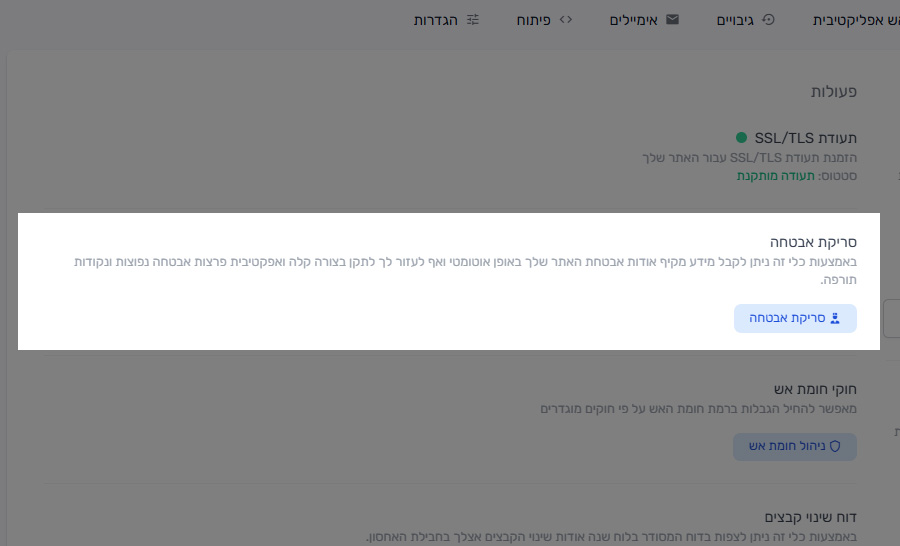 Original Hebrew uPress control panel. Follow the English instructions in this article; labels and positions may differ in the current interface.
A CDN service such as Cloudflare
CDN (Content Delivery Network) services act as a buffer between the site and the internet – they filter malicious traffic, block DDoS attacks and prevent direct access to the server where the site resides. In this way they significantly reduce the risk of damage or downtime. In addition, they also speed up the site by serving copies of it from distributed servers around the world. With well-known hosting companies you can connect the site to such a service directly the hosting interface, without needing complex settings and technical knowledge. It is therefore worth seriously considering, certainly in sensitive periods, routing your site through such a service.
WAF – the gatekeeper of the site itself
A website, by its nature, is open to the world, and the world, what can you do, also includes bad actors. A WAF – Web Application Firewall – acts as a buffer between the outside world and the site. A kind of digital gatekeeper – every request entering the site, such as a form, a search or a login, passes through it for inspection. If it detects anything unusual or suspicious – such as a hacking attempt, code injection or an automated scan – it stops it before the request even reaches the site itself. A quality WAF will markedly reduce the common risks to sites and in many cases has saved sites that were not properly maintained. This should not, heaven forbid, be taken as a recommendation to neglect your site, but it is certainly highly recommended to arrange such a service.
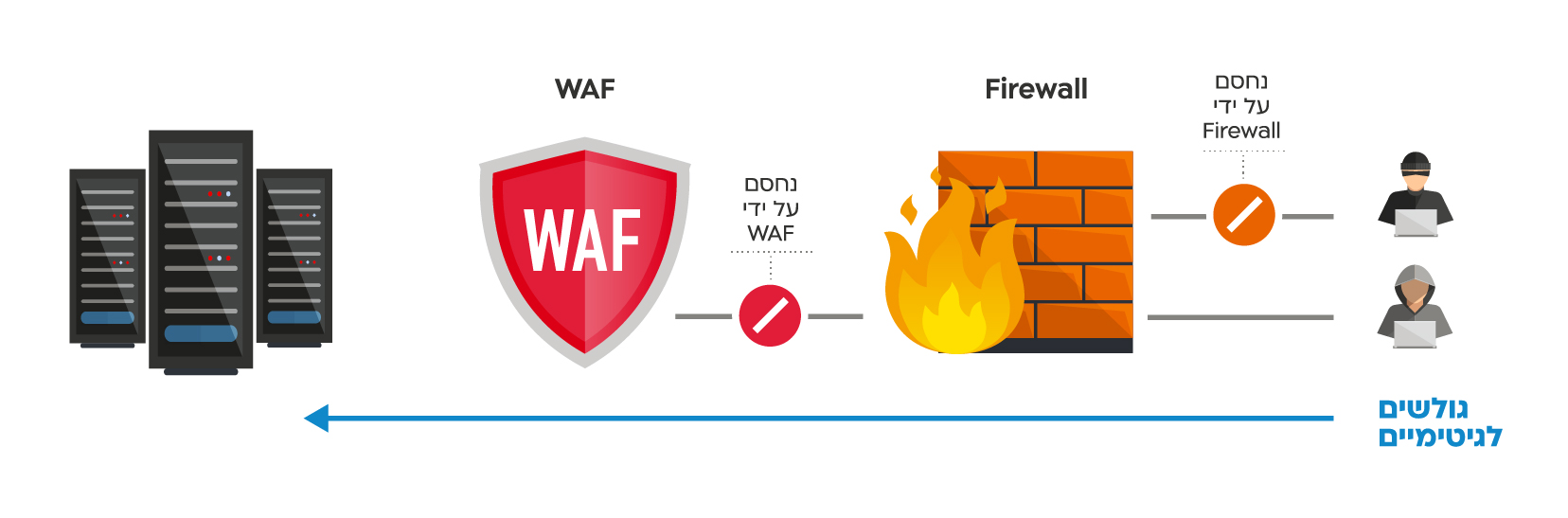 Security layers: the firewall filters network traffic, and the WAF adds application-level protection before requests reach the web server. Original Hebrew illustration.
Summary
Most sites are hacked not because they are interesting – but because they are vulnerable. Please pay attention to this.