
If you have followed all the buzz that Facebook's HHVM created, you know that HHVM created the beginning of the revolution.
HHVM – HipHop Virtual Machine is a Facebook project that takes PHP and dresses it with the performance of a race car.
HHVM can significantly improve the performance of the PHP language, at a speed of at least 2x compared to the speed obtained with PHP 5.6, relative to working with WordPress sites.

While Facebook's HHVM created the beginning of the revolution, PHP arrives right away with an immediate answer.
Now, PHP 7 shows significantly better performance than PHP 5.6 (the last version before it), competes respectably and even overtakes Facebook's HHVM project, which left regular PHP in the dust in recent years.
What's all the buzz about?
After years of waiting, endless hours of development, incessant professional arguments on every possible subject, PHP releases the final and official version of PHP 7.

Anyone who uses or follows what is happening in PHP has probably noticed that for a very, very long time no major update of the language has been released.
To be precise, from July 2004, when the major version of PHP version 5 was released.
For illustration, the first, original iPhone was released only about 3 years later,
the Chrome browser was released only after about 4 years,
and the Firefox browser was just starting out (about 4 months).
Now, considering that PHP is in a constant struggle against newer programming languages, and in addition HHVM, Facebook's project that takes PHP and dresses it with improvements,
We understand the importance of this critical upgrade.
critical to the language's continued existence and to its continued standing as one of the three most popular programming languages for the Web today.
What happened to PHP 6?
First of all, it is not a mistake. After several years of trying to develop PHP 6, which included support for Unicode in the language, The project was abandoned (due to a lack of manpower and mainly a lack of public interest).
A long and stormy debate in the PHP community led to a final decision (by democratic vote, 58 to 24) to skip version 6 and name the next version PHP 7.
What are the key differences in PHP 7?
As mentioned, there are many changes and innovations in PHP 7, but the most important and noticeable one is system performance.
The PHP developers carried out a complete rewrite of the Zend Engine, which sits behind the scenes of PHP.
To read the full changelog of PHP version 7 – click on the following link. And the full list of changes In the following link.
Version 3 of the engine was developed from a project called phpng, whose aim was to improve the language's performance.
Initial tests of phpng showed a 100% improvement in performance compared to WordPress, and in some cases even more than that.
Toward the end of the development process, PHP 7 shows significantly better performance than PHP 5.6 (the last version before it)
and competes respectably, and even surpasses, Facebook's HHVM project that has left dust on PHPP in recent years.
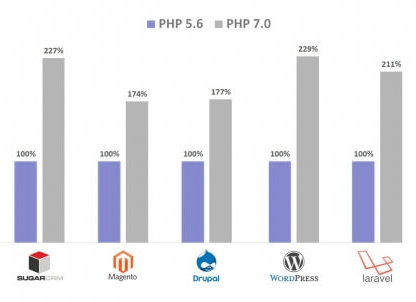
The comparison in the graph shows the performance improvement of PHP 7 over 5.6 on several content management systems such as WordPress:
In addition, the following graph shows the performance differences by displaying the number of requests to the server that can be made in 1 second, respectively:
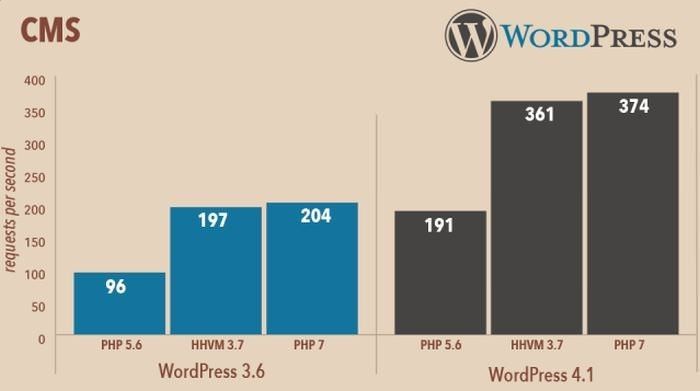
One of the great advantages of PHP 7 over HHVM is achieving almost identical performance (expressed in speed) for WordPress sites, with a much simpler way of operating and implementing it.
If you want to experiment with PHP 7, now is the best time.
PHP 7 is more stable than ever, with support from plugins and design themes, at least if they have been updated in the last two and a half months.
uPress provides hosting packages with a server array based on PHP 7. To go to the packages page Click here.
After talking with several of our customers, we got the feeling that there is some concern among users about upgrading to PHP 7 because certain plugins do not support it.
We decided to test a number of plugins, and we can confirm that the following plugins fully support PHP 7:
- WP Rocket
- Disqus Comment System
- Smart Slider 3
- P3 – Plugin Performance Profiler
- Duplicator
- W3 Total Cache
- Plugin Organizer
- BuddyPress
- WP Super Cache
- Akismet
- bbPress
- Formidable Forms
- Shareaholic – share buttons
- Custom Post Widget
- Simple Map
- Blog Time
In general, if you are developers who think a little outside the box – you'll be fine.
Perhaps a plugin or two will not work perfectly, but it is a matter of time until they receive an update with PHP 7 support; you can find a temporary replacement for them.
If you are using an abandoned plugin (that hasn't been updated for a very long time), you have 2 options: find an alternative plugin or use PHP in the old version prior to 5.5.
If you are using a plugin that is not adapted to version 7, the best thing you can do is to notify the plugin's author. If you are lucky, the author will quickly release a version that supports version 7.
Which leads us to the general question: how do I know the plugin will receive support in the future?
I assume the best answer is simply to use plugins created by highly reputable companies (Automaticc, StudioPress, MyThemeShop, ElegantThemes, and more…)
WordPress is a very flexible system, and for every good working plugin there are at least 3 alternatives at the same level, so take advantage of this.
If you are uPress customers or want to be, your hosting package is set by default to PHP7,
Of course, you can control the PHP version by going to the admin panel > Settings tab > Manage PHP settings.
In summary:
We hope this article helped you learn the importance of PHP version 7 for your WordPress site, and how many advantages the new version can provide you.
Our goal at uPress is always to bring the advances of the WordPress hosting world, to serve as pioneers in our field, and to lead technological superiority.
If you have any further questions about any subject related to this article, we will be happy to answer them.
