
What is the HTTP/2 protocol, anyway?
HTTP/2 is the first major upgrade of the HTTP communication protocol.
since 1999, when HTTP/1.1 was officially published by the IETF (Internet Engineering Task Force).
The HTTP/2 protocol is based on the SPDY network protocol, originally developed by Google.
 Timeline comparing HTTP protocol versions. Original Hebrew chart.
The new HTTP protocol is designed to keep pace with the technological growth of the internet.
The structure of websites has changed dramatically in the interim period, with growth in the number of images, CSS files, and JavaScript files that are loaded from external links, and the number keeps growing every year.
HTTP/1.1 was not designed for this type of site structure. HTTP/2, on the other hand, is specially adapted to the modern site structure, and brings a significant improvement in resource efficiency, better performance, and improved security.
and the big plus – it is supported by the vast majority of modern browsers.
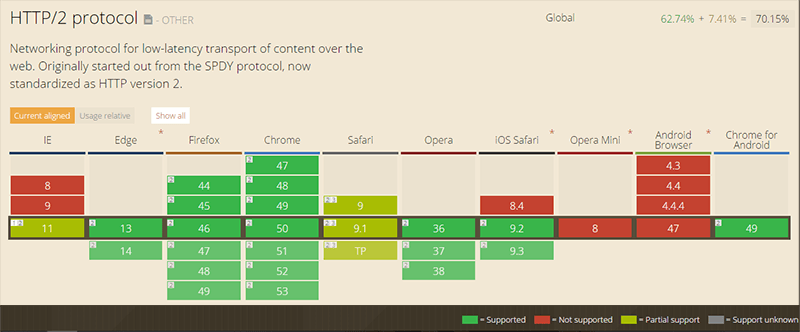
The list of browsers that support HTTP/2 can be found In the following link.
Speed improvement
Using HTTP/2 is expected to improve your website's speed without any change to existing code on your side (the setting is done on the server side).
Cloudflare ran a speed comparison experiment. The experiment included splitting an image into 200 equal pieces, and loading the image over the HTTP/1.1 protocol and then the same image over the HTTPS/2 protocol.
The browser is required to use about 200 separate TCP connections for each image, and this results in higher-than-usual overhead and a delay in image loading over the HTTP/1.1 protocol, because only a small number of TCP connections can be used within a given period of time.
In contrast, the new HTTP/2 protocol is able to use a large number of TCP connections within a defined period of time,
and this brings an improvement of up to 12 times in the connection time between the client and the server.

Significant speed improvement with the HTTP/2 protocol, an experiment by Cloudflare
In summary
In summary, the HTTP / 2 protocol came to solve quite a few flaws of the HTTP / 1.1 protocol.
and in addition to fixing the flaws, it presents many advantages, the main ones being:
- Support for multiple parallel connections – Several requests can be sent in quick succession over the same TCP connection.
- Stream dependency – The client can indicate to the server which resources are more important and where to place greater importance than on the others.
- Header compression – The size of the HTTP header is drastically reduced.
- Server push – The server can actually send and push resources that the client has not yet requested, and tuck them into the browser cache even before they are requested.
